Tuesday, 19 April 2011

Grow Your Own


2007 - Dir: Richard Laxton - Shown at the FeckenOdeon on 30th April, 2011


This film did not begin - as most films do - with a round of pitches and commissions in film company offices. It grew from a seed that was planted and nurtured in "Art in Action" - a long-established community arts project based in Bootle. Bass player Carl Hunter was asked to make a short video to promote and help raise funds for an extraordinary enterprise. The Family Refugee Support Project in Liverpool tries to help people who have had terrible experiences in their home countries, and who are trying to cope with the physical and mental aftereffects of those experiences in the sometimes inhospitable atmosphere of their adopted city. Under this scheme, these people were given - not drugs - but allotments.


Carl realised that there was more than a fundraising video in this story and took it to the BBC who pulled in extra funding, director Richard Laxton and a lot of familiar character actors. Carl was given help to write his first ever screenplay - given the working title of "The Allotment". The result is a bit of an odd hybrid - part Ealing comedy, part social comment. It can be said to work on both levels. Many people have allotments (there are two sites here in Feckenham) and regard them as their private escape - how people react when their space is invaded is always good dramatic fuel.


And what happened next? The project upon which this film is based was refused funding by the Lottery and by Government Agencies. Perhaps a lesson for our current financial predicament - nothing grows unless you water it!

Monday, 21 March 2011

The Rocket Post


2004 (Limited release in Scotland only) / 2006 (Limited UK release) - Dir: Stephan Whittaker


Shown at The FeckenOdeon on 26th March, 2011


This films holds the dubious record for the longest time taken from shooting to showing in the cinema. In 2002, it won a major prize at the Stony Brook Film Festival in New York State, and there were other special screenings, including one at the An Lanntair arts centre in Stornoway in 2005. The film even came out on DVD in Scandinavia, but still took years to find a UK distributor. Sadly the director died before his work hit the big screen and the producer took up an new career promoting wind farm technology. The rather lame explanation given by the distributors who eventually gave it a very limited release was that the film would not have appealed to the young people who inhabit multiplex cinemas - and these are the same people who regard the film society movement as a "minority market". Haven’t they heard? We’re all living longer!


The cast of this £5m production, shot largely on the Hebridean island of Taransay in 2001, includes Trainspotting star Kevin McKidd, Gary Lewis from Billy Elliot and newcomer Shauna Macdonald. Not in any way edgy or challenging, The Rocket Post does what British films do best – light, quirky comedy with lots of familiar faces, picture postcard scenery, a splash of romance and a dash of drama.


The real Gerhard Zucker appears to have been a bit of a charlatan. In the early 1930s he organised a number of rocket demonstrations in German villages. The impressive rocket was really a large canister with some large fireworks stuffed up the rear end. It took off with an impressive roar, rose about 15 metres and then inevitably crashed to the ground. Zucker made money by selling postal covers which (fraudulently) claimed to have been transported by one of his rockets. After the war he became a furniture salesman but was unable to resist further experimentation with rockets. In 1964 one of his contraptions went out of control and killed a bystander. This led to all non-military rocketry being banned in Germany. Undeterred Zucker resumed launching fraudulent 'rocket postal covers'. Having done a great deal to set back scientific rocketry in Germany, Zucker died at home in his bed in 1985.

Wednesday, 9 March 2011

Round Ireland With A Fridge


2010 - Dir: Ed Bye


Shown in FeckenOdeon 2 on 16th March, 2011


The current state of the film distribution industry in Britain means that very few home grown films are shown in mainstream cinemas. It’s a situation that’s been exacerbated by the introduction of Digital Cinema. The very technology that should have made it possible for cinemas to be flexible and adventurous in their programming has been used to narrow the choice even further. Because the equipment needed for digital projection is so expensive it has been necessary for cinemas to enter into finance deals with the large American studios.. which, of course, means that the studios expect the cinemas to show their films and very little else. There are token nods towards diversity in the form of "alternative content" - operas and sporting events - but in reality the multiplexes are condemned to a sold diet of "RoboPotter of the Caribbean Part 9" and our British film makers are forced out into "straight to DVD" or, even worse, free distribution on the internet or direct to your mobile phone.

Tonight’s film is a case in point. Firstly the Americans liked the book. They said they might like to make a film of it. Then they said nothing. Then they said maybe. Then they said nothing again. Then Tony Hawks said "Sod it! I’ll make the thing myself". So he did. And then no-one would touch it. A minor distributor toyed with it, put it out on DVD... and walked away. It didn’t even get a showing on the telly. And there things would have languished if Mr Hawks hadn’t been made of sterner stuff. He got in touch with community cinemas like The FeckenOdeon as well as film festival organisers to tell them that he’d got a good British film - and would we like to show it? It’s not the best film or funniest film or the glossiest film ever made - but it’s a happy, professionally made hour and a half of entertainment. The sort of thing we like in Britain... and certainly in Feckenham!


This story has been repeated many times over in recent years. Even our next film in the main cinema has suffered - it took the producers no less that 7 years to get a very limited UK release for "The Rocket Post". We’re now getting offers of British movies that in the past would have had a guaranteed modest showing on the big circuits. Do it yourself is now seen as the only way forward. There are over 350 film societies in the UK and there are about 100 full time independent community cinemas - that’s a "circuit" of about 450 screens and it may well be the only way for British films to be seen by the public they were made for. We shall be delighted and proud to play our part!

Monday, 21 February 2011

To Have and Have Not


1944 - Dir: Howard Hawks


Shown at The FeckenOdeon on 26th February, 2011


Hemmingway wasn’t too proud of his book "To Have and Have Not". Warner Brothers didn’t think much of it either but they’d bought the rights and wanted to make some money on the investment. The solution was to get William Faulkner and Jules Furthman to completely rewrite it (it remains in the same setting and the theme of rum running survives). They then threw their hottest property (Humphrey Bogart) at it and got Howard Hawks, one of the steadiest hands in the business, to direct it. All seemed set for a solid but rather unexciting film that would have done modest business even during wartime... but then there was Lauren Bacall.


Hawks had spotted Bacall in New York where she was a model and bit part stage actress. He persuaded her mother to let her travel to Los Angeles, signed her to a Warner Bros contract, and spent many months grooming her for a major role in the movies. There’s little doubt that Mr Hawks regarded the nineteen year old Bacall as his protege and expected a "reward" for his attentions. But then Bacall met Bogart on the set... Mr Hawks was not best pleased. Bogart was married to actress Mayo Methot but the marriage was on the rocks - largely due to Mrs Bogart’s overindulgence in whisky on the rocks.


Bacall claims to have been so nervous during the shoot that she trembled almost uncontrollably before takes. If that’s the case there’s not a sign of it in the finished movie where she can be said to smoulder rather than shiver. When the film was released she was the sensation of the moment. Despite the studio’s misgivings the story of their whirlwind romance was lapped up by the public and they became one of Hollywood’s most established and stable pairings. Howard Hawks never spoke to Bogart again.

Sunday, 20 February 2011

Snow White & the Seven Dwarfs


1939 - Dir: Walt Disney with six sequence directors

Shown at the FeckenOdeon on 26th February, 2011

This is the first full length animated feature film ever made. It hadn’t been thought that animation could sustain anything more that a few minutes of madcap merriment involving mice and chases. Walt Disney was convinced that a really well made film with strong characters and a good plot could work as well, if not better, than any live action picture.


Disney's inspiration was not in creating Snow White but in creating her world. At a time when animation was a painstaking frame-by-frame activity and every additional movement detail took an artist days or weeks to draw, Disney imagined a film in which every corner and dimension would contain something that was alive and moving. From the top to the bottom, from the front to the back, he filled the frame. So complex were his frames, indeed, that Disney and his team of animators found that the cels they used for their short cartoons were not large enough to contain all the details he wanted, and larger cels were needed. The film's earliest audiences may not have known the technical reasons for the film's impact, but in the early scene where Snow White runs through the forest, they were thrilled by the way the branches reached out to snatch at her, and how the sinister eyes in the darkness were revealed to belong to friendly woodland animals. The trees didn't just sit there within the frame. Nothing like the techniques in ''Snow White'' had been seen before. Disney demonstrated how animation could release a movie from its trap of space and time; how gravity, dimension, physical limitations and the rules of movement itself could be transcended by the imaginations of the animators.


Ironically it’s only today, through the wonders of High Definition Digital projection, that we can see the film as Disney wanted it to be seen. No worn projectors, scratches, dust or colour fade - just rock solid, pin sharp animation - every frame (or field in modern technospeak) is a work of art in its own right.


  • The film took 750 artists four years to make.


  • From many who auditioned for the voice of Snow White (Walt turned down Deanna Durbin), he chose the young singer Adriana Caselotti. Harry Stockwell, the father of Dean Stockwell, did the voice of the prince.


  • For a while after its release the film was the highest-grossing motion picture of all time, until it was finally surpassed by "Gone With the Wind" a couple of years later.


  • In England, the film was deemed too scary for children, and those under 16 had to be accompanied by a parent.

Monday, 7 February 2011

The Concert


2009 - Dir: Radu Mihaileanu

Shown in FeckenOdeon 2 on February 11th, 2011

You may need an extra hankie for this one! It’s advertised as a comedy and much of it is very funny - but even the hard bitten critic of the Daily Mirror was forced to admit that he was reduced to tears by the end. If you think about it this is an odd subject for a comedy. Doubly so when you realise the basic premise - that, in the Soviet Union of the 1960s, Jewish musicians suffered in much the same way as they had in Nazi Germany - is a bit flawed. The director has said that the conductor Filipov is ‘inspired by real-life conductor Evgeny Svetlanov’, which is odd because although Svetlanov was indeed principal conductor at the Bolshoi, this was in 1962-1965 - long after the anti-semetic excesses of Stalin. At no time in his long career was Svetlanov linked with political controversy involving Jewish musicians - but this is fantasy where the facts should never be allowed to spoil a good story! Perhaps it was never intended to be "true to life" as it pokes critical fun at what lies behind power, ambition and even failure.

There are terrific performances by its Russian-Franco-Romanian cast and fantastic playing by the (hidden) musicians of the Budapest Symphony Orchestra. Melanie Laurent’s violin playing is dubbed by Sarah Nemtanu of the Orchestre National de France - who doesn’t even get a credit!

Sunday, 9 January 2011

The Sting


1973 - Dir: George Roy Hill

Shown at The FeckenOdeon on 29th January, 2011


Having succeeded in the Old West, director George Roy Hill turned his talents to that other rich vein of popular rebel mythology - and good cinema - prohibition-era gangsterville. Hill's film is almost a sequel to "Butch Cassidy and the Sundance Kid" in that it follows a similar formula and although set in 1936 Chicago, the two heroes retain the same characteristics. Close attention is paid to building period detail, and one of the film’s major strengths is its atmospheric recreation of the mean streets of Chicago. The plot gets complex quickly. But don't worry. For those with fashionably short attention spans, titles with different chapter headings break the plot into easily digestible chunks.
"The Sting" became one of the biggest hits of the early '70s; grossing 68.5 million dollars during its first run, the film also picked up seven Academy Awards, including Best Picture, Best Director, Best Screenplay, and Best Adapted Score for Marvin Hamlisch.
  • The movie is based on the real-life exploits of grifter brothers Charley and Fred Gondorf, whose experiences culminated in a scam similar to the one shown in the film, known in 1914 as "the wire" or "the big store". Unlike the movie, however, the actual "mark" was more than happy to testify against Charley Gondorf, the front man of the scam, and he spent time in Sing Sing, as did his younger brother a year later for running another scam. Both served a few years and were released. As late as 1924, when Charley was 65 and Fred 60, they were still active, and running new scams.

  • The movie was filmed on the backlot of Universal studios and the diner in which Hooker meets Lonnegan is the same diner interior used in "Back to the Future".

  • Although "The Sting" helped bring Scott Joplin's rags back into popular culture, they actually predate the period of the story by 25 years and wouldn’t have been heard in the 1030s.

  • When Elizabeth Taylor announced that "The Sting" had won and Oscar for Best Picture a streaker ran accross the stage. A few years later the same streaker was found dead in an art gallery. The two events are not thought to have been connected.... or were they?

Saturday, 11 December 2010

Oklahoma!


1955 - Dir: Fred Zinnermann

Shown at the FeckenOdeon on December 27th, 2010

Rodgers and Hammerstein's 1943 stage musical was considered revolutionary for a multitude of reasons, not least of which were the play's intricate integration of song and storyline, and the simplicity and austerity of its production design. This 1955 film version of Oklahoma! retains the songs and the story, but the simplicity gives way to the spectacle of Technicolor, Todd-AO, and Stereophonic Sound. Nine years is a long time in showbiz so the original Broadway stars were overlooked in favour of newer talent - though Aunt Eller is played by Charlotte Greenwood who the part was written for (illness had prevented her from playing it on the stage).
THE PLOT & CAST
The story can be boiled down to a single sentence: a girl must decide between the two suitors who want to take her to a social.
In her movie debut, 19-year-old Shirley Jones plays Laurie, an Oklahoma farm gal who is courted by boisterous cowboy Curley (Gordon MacRae) and by menacing, obsessive farm hand Jud Frye (Rod Steiger). Counterpointing the serious elements of the story is a comic subplot involving innocently promiscuous Ado Annie (Gloria Grahame), her erstwhile sweetheart Will Parker (Gene Nelson) and lascivious oriental travelling salesman Ali Hakim (Eddie Albert) - who looks and sounds as if the closest he’s been to the orient is the Bronx.
It’s all very jolly stuff and, as you might expect, the story ends on a high with the pioneering Oklahomers singing of the great future they and their newly minted state can look forward to... It’s ironic to note that the real settlers overworked the land and created the dust bowl chronicled in Steinbeck’s harrowing "Grapes of Wrath"....

TWO FOR THE PRICE OF ONE!

Oklahoma! was made twice at the same time... There were two versions. One was the general release CinemaScope version we’re seeing tonight. The other was the first film ever to be made in ToddAO - a process which used film 70mm wide (twice the width of the standard 35mm film) and which produced pin sharp pictures on the very biggest of screens - the ToddAO version was only shown in large city centre theatres. Director Fred Zinnermann and his long suffering cast shot each scene separately for the two versions - a long and tedious process which, we’re told, resulted in two subtly different movies. We’ll have to take their word for it because the ToddAO version no longer exists - 20th Century Fox ditched most of the prints and those that do survive are but faded shadows of their former glory. The print you’re watching tonight is a digital restoration of the 35mm version.

SHALL WE DANCE?

Just before the interval we’re treated to a classic 1950s Hollywood ballet - it’s all just a bad dream and it’s just as well because it’s all a bit strange. For some reason the leading characters are danced by people who don’t look a bit like them... except for Rod Steiger. It’s well executed but it seems to belong in a different film - it’s quite a relief to wake up in good old folksy Oklahoma again!

ELEPHANTINE CORN

Finding "corn as high as an elephant's eye" proved to be quite a challenge. Since filming was to take place out of season, no tall cornfields were to be found anywhere. The job was given to the people of the University of Arizona Agricultural Department, who planted each stalk in individual containers and held their breath. With rain and good luck, the corn grew to a height of 16 feet, causing Oscar Hammerstein to quip: "The corn is now as high as the eye of an elephant on top of another elephant."

Saturday, 20 November 2010

Citizen Kane


1941 - Dir: Orson Welles
Shown at the FeckenOdeon on 27th November, 2010


What can one write that hasn’t already been written a thousand times about Citizen Kane? "The greatest film ever made"... a debatable assertion but who can deny that this is a remarkable piece of work. Roger Ebert, distinguished critic of the Chicago Sun Times has analysed the film more than 30 times over the years and still can’t help being drawn back. Perhaps it’s best to let him introduce it:
"The origins of "Citizen Kane'' are well known. Orson Welles, the boy wonder of radio and stage, was given freedom by RKO Radio Pictures to make any picture he wished. Herman Mankiewicz, an experienced screenwriter, collaborated with him on a screenplay originally called ``The American.'' Its inspiration was the life of William Randolph Hearst, who had put together an empire of newspapers, radio stations, magazines and news services, and then built to himself the flamboyant monument of San Simeon, a castle furnished by rummaging the remains of nations. Hearst was Ted Turner, Rupert Murdoch and Bill Gates rolled up into an enigma. "Citizen Kane'' covers the rise of the penny press (here Joseph Pulitzer is the model), the Hearst-supported Spanish-American War, the birth of radio, the power of political machines, the rise of fascism, the growth of celebrity journalism...."

  • William Randolph Hearst was infuriated by this movie, obviously based on his life. "Rosebud" was Hearst's pet name for a certain part of the anatomy of his long-time mistress Marion Davies.
  • The film flopped when it first opened - this may have had something to do with the panning Hearst’s papers and radio stations gave it. Hearst also ordered his advertising departments not to accept ads for theatres showing the film.
  • Ted Turner had plans to "colorize the film. Welles hear about it and roared ""Tell Ted Turner to keep his crayons away from my movie!". The film has never been tampered with.

Wednesday, 10 November 2010

The Ghost


2009 - Dir: Roman Polanski

Shown in FeckenOdeon 2 on November 19th, 2010

“It’s harder than usual not to think about Roman Polanski and his self-induced messy life when watching The Ghost. That the film was edited and completed while Polanski was under house arrest in a chalet in Gstaad only adds to the sense that the fear and paranoia hovering over its every scene emerges from distinctly personal disquiet.”... well, that’s the opinion of the Daily Telegraph’s film critic Sukhdev Sandhu. Robert Harris who wrote the novel and the screenplay and worked closely with Polanski throughout doesn’t agree. He says that Mr P was on top form - full of energy, acting out every scene and attacking the job with creative energy crackling from every pore. Even when arrested he cut himself off from the distractions of legal action and imprisonment - the film was completed using a laptop and the Internet. The truth, as so often is the case, probably lies somewhere in between. Polanski is a director of vast experience. His craftsmanship is stamped on every scene and, even though Mr Harris’ script on occasions drives a coach and horses through logic and credibility, Polanski sews it all together with such skill that we believe every frame. The man is a professional - if you gave him the script of Carry on Camping and asked him to make a thriller out of it a thriller is exactly what you would get - polished, compelling and literate.... Only after the film was over would you start to wonder about the holes in the plot....

Is this based on Tony and Cherie? Mr Harris says “sort of”. Well of course it is! Which other contemporary British Prime Minister took the country to war in the Middle East? Ok - John Major did it as well - but there’s no sign of Edwina Currie hiding in the wardrobe and you never catch even a glimpse of the top of Pierce Brosnan’s underpants. It has to be Blair... but it’s unfortunate that the media, ever seduced by a whiff of scandal, had little to say about the film itself but everything to say about the Blairs and Mr Polanski’s lurid past (it’s 33 years past). As a result this really very good thriller enjoyed a quick week in the multiplexes before being pensioned off to await a video release. It deserves better!


  • Ewan McGregor’s character never had a name. McGregor invented “Gordon McFarquor” so that he’d have an identity to work with. The credits simply list him as The Ghost.

  • Because Polanski couldn’t travel to the United States, much of the filming took place in Germany. The island of Sylt stood in for Martha’s Vinyard.

  • Pierce Brosnan said during a promotional interview, "It's sad for all concerned, but it's also heightened the movie. The movie's in the can, Polanski's in the can."

  • In the film The Ghost is given a manuscript by Lang's attorney. In the taxi he checks the number of pages: 624. Tony Blair's memoirs A Journey, published in September 2010 (after the film had been released) also has 624 pages.... spooky!

Monday, 27 September 2010

Flawless


2008 - Dir: Michael Radford

Shown at The FeckenOdeon on October 30th, 2010

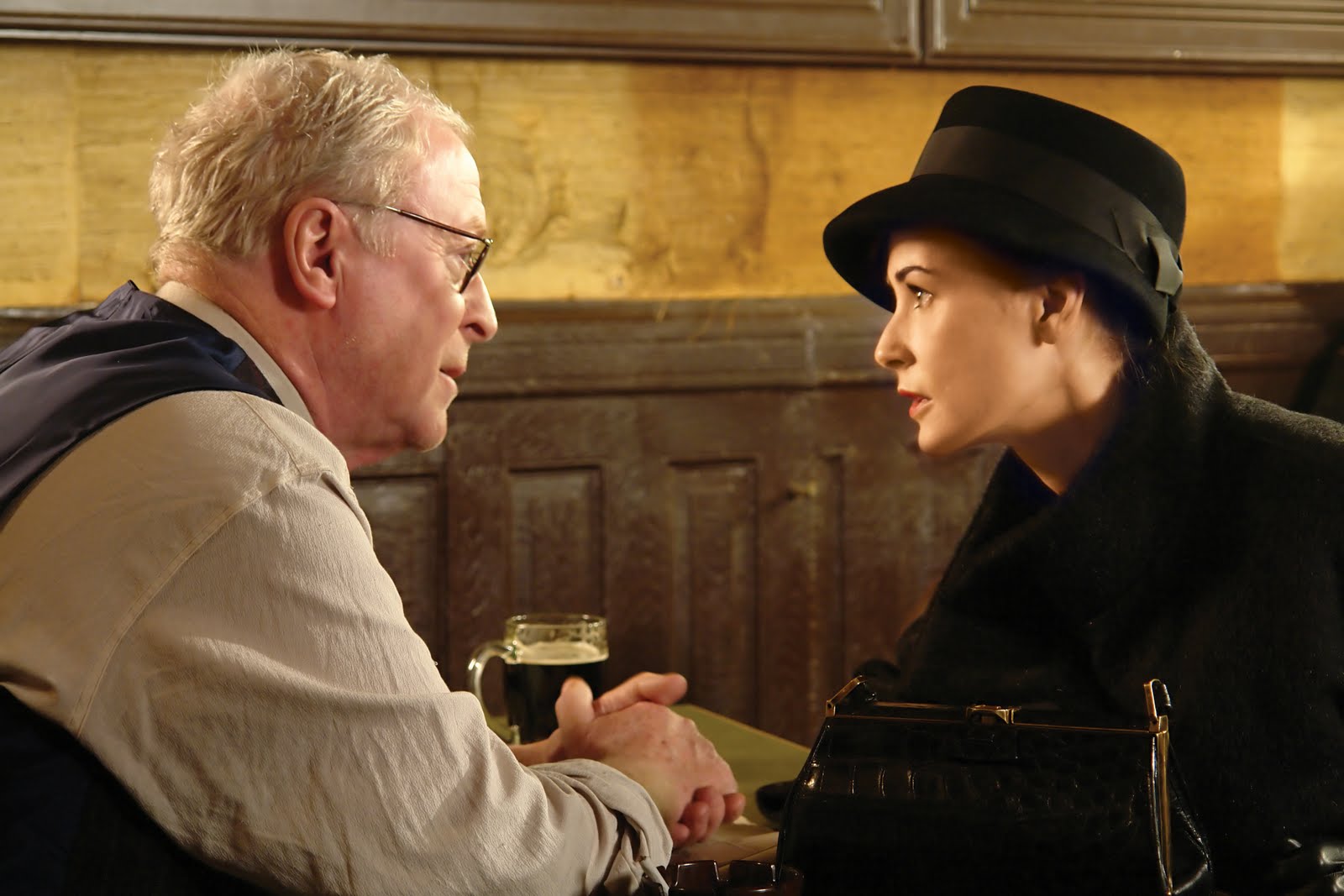
This is a modern, slick piece of filmaking with a difference. While "Flawless" follows the rules of the crime thriller genre, it does so in a kinder, gentler manner than many of its contemporaries. This movie has no chases or killings and lacks many of the violent trappings audiences have come to expect from heist movies. In fact, one could make a convincing argument that, although the production is primarily about the planning, execution, and aftermath of the crime, it's actually an unconventional love story. This is a strange and tense film - more of howdunnit than a whodunnit. We meet a high flying business woman (Demi Moore) who slightly improbably teams up with the company janitor (Michael Caine) to steal some Flawless diamonds. The robbery, its planning and execution, are exciting enough - but it’s only then that we get to the meat in the sandwich.... to say much more would be to say too much...
It’s 40 years since Michael Caine blew the bloody doors off the conventions of crime movies in "The Italian Job". Now he’s at it again - proving once and for all that pensioners are just young hoodlums in old skins. Mr Caine, now 77 years old, never seems to stop working. It can’t be for the money so the only conclusion can be that he simply loves the job. Since this film he’s completed another six and is now working on a further two projects - including the next in the Batman series. Mr Caine is supported by a fine cast of British character actors including Joss Ackland who is 83 and Derren Nesbitt aged 75... not a lot of peopl
e know that...

Wednesday, 18 August 2010

The Pope's Toilet


El Baño del Papa
2007 - Dir: César Charlone & Enrique Fernández

Shown in FeckenOdeon 2 on September 17th, 2010


The Pope is coming to the UK - in fact he’s here today and will be doing a bit of canonisation and sprinkling of Holy Water in Brum on Sunday. Needless to say that the streets around the venue will be taken over by the purveyors of dubious souvenirs, fast food wagons and programme sellers. It happens everywhere for every type of event where thousands of people are expected. Been there - got the T shirt is the glib phrase but.. Beto’s story couldn’t happen here... or could it? When a country is in the grip of economic disaster people tend to take desperate measures to earn a crust. Admittedly we’re not starting from as low a point as Ecuador - we can at least afford flush toilets.... for now....
This bittersweet film comes right from the heart. The action tales place in Melo in North Eastern Uruguay. It’s about the same size as Redditch and it’s desperately poor. It’s also the home of the director César Charlone and many of the people acting in it are local amateurs. The story is imaginary. The poverty isn’t.
In 1988, when the Pope visited, Uruguay was just emerging from years of brutal dictatorship and, despite the first flutterings of fledgling democracy, the old guard found it hard to let go. The struggle to exist was still being made even harder by corrupt officials like the border guards who terrorised Beto. None of this is fictitious and all of this is still happening. It would be easy to let all this overshadow the essential message of The Pope’s Toilet - that the spirit and good humour of people is difficult to quash ... a bit of the blitz mentality surfacing in South America
?